Tag: adr

  • You need to be aware of yourself before you can resolve a conflict.

    NYLT_Ken Strongman 09 aware
    aware of yourself

    If you are upset or angry, it affects how you relate to others.  You must be aware of your own emotions.  We all have them, so don’t deny them.  If necessary you may need to call a time-out to let your own emotions cool down.

    It is not just having an understanding of your own emotions.  I know that my mediations do not go well if I have a personal distraction.  The distraction doesn’t have to have anything to do with the situation at hand.  It could be something simple like I have less that a quarter of a tank of gasoline in my car, or more complex like there are difficulties at home.  

    Make sure that you have minimized all of your personal distractions.  Be neutral and level headed.  Be aware of your own emotions.  If you are a team leader confronting conflict, you need to keep track of the team’s vision along with your own emotions, wants and desires.

    Finally, if you own the cause of the problem, you may not be the best to resolve the conflict.

    **For the last decade I’ve been involved with leadership development of tomorrow’s leaders.  Using my expertise, I am training the youth leaders in conflict resolution.  This blog is adapted from my training materials. 

     Ken StrongmanAbout the Author: Ken Strongman (www.kpstrongman.com) has years of experience and a growing national reputation as a mediator and arbitrator.  He has successfully resolved more than a thousand disputes in the fields of construction defects, real estate, intellectual property, and employment.  He is also a Mediator and Arbitrator for FINRA.

    © 2020 Ken Strongman. All Rights Reserved. Please do not copy or repost without permission.

  • FAQ: What is Mediation?

    FAQ_Mediation Mendocino 02
    What is Mediation?

    Mediation is a form of alternative dispute resolution (ADR), which can be used as a way of resolving a dispute between two or more parties with the assistance of a mediator who acts as a neutral third party and facilitates the process with a view to the parties voluntarily negotiating a settlement of their dispute.  In all of the mediations in which I served as a mediator, I have never dictated the solution to the dispute to the parties.  I have offered suggestions and ideas that they may not have considered. 

    Mediation usually has a structure, timetable and process established and agreed by the parties with the mediator which can help it to be a more effective dispute resolution process than a traditional settlement meeting. The process is private, confidential, without prejudice and non-binding, although the objective is to reach a resolution of the dispute by agreeing to binding settlement agreement.

    It cannot be stressed enough that mediation is a completely voluntary process where the parties with the assistance and guidance of the mediator reach a solution to a dispute that is satisfactory to all parties.  The parties are in complete control of the solution. 

    Ken Strongman, MediatorAbout the Author: Ken Strongman (www.kpstrongman.com) has years of experience and a growing national reputation as a mediator and arbitrator.  He has successfully resolved more than a thousand disputes in the fields of construction defects, real estate, intellectual property, and employment.  He is also a Mediator and Arbitrator for FINRA.

    © 2020 Ken Strongman. All Rights Reserved. Please do not copy or repost without permission.

  • Steps to Resolve Conflict.

    NYLT_Ken Strongman 08
    Steps to resolve conflicts.

    There are basic steps to resolve conflicts. All leaders are bound to encounter difficulties between two people or groups.  This will happen when the team is in the ‘storming’ stage of team development.  In this stage the conflict may not be completely obvious.  It’s quite true that some will act out their issues.  Others can become extra quiet and withdrawn.

    The simple steps to resolve any conflict are:

    ·     Be aware of yourself.

    ·     Be aware of others.

    ·     Listen.

    ·     Use your EAR.  [Express, Address, Resolve.]

    **For the last decade I’ve been involved with leadership development of tomorrow’s leaders.  Using my expertise, I am training the youth leaders in conflict resolution.  This blog is adapted from my training materials. 

     Ken StrongmanAbout the Author: Ken Strongman (www.kpstrongman.com) has years of experience and a growing national reputation as a mediator and arbitrator.  He has successfully resolved more than a thousand disputes in the fields of construction defects, real estate, intellectual property, and employment.  He is also a Mediator and Arbitrator for FINRA.

    © 2020 Ken Strongman. All Rights Reserved. Please do not copy or repost without permission.
  • FAQ: Do I have to have a lawyer at my mediation?

    FAQ_Mediation Mendocino 03 lawyer
    Lawyer at mediation?

    Do I have to have a lawyer at my mediation?

    No, it is not necessary to have a lawyer representing you at mediation. If you have a lawyer already representing your interests in the dispute you would need to discuss this with him or her.  If you feel you need legal advice or that you are unqualified or uncomfortable dealing with the issues on your own, then you should consult a lawyer and perhaps hire someone on an hourly basis solely for the purpose of representing you at the mediation.

    If, on the other hand, you are involved in a dispute that you feel comfortable resolving without a lawyer, keeping in mind that your mediator will not give you legal advice or advocate on your behalf, by all means, make an attempt to resolve it on your own first.

    Do remember that the other party has a right to hire an attorney and to bring them to the mediation to help represent them.  If that scenario occurs, there will be no one to advocate your interests. You will not have a right to delay the mediation to hire your own attorney.

    Mediation is a voluntary process that centers on discussions and decision-making, rather than judgment. It is focused on resolving disputes based on the factual circumstances, the needs of the parties and practicality, and not solely on the legal rights of the parties (sometimes, despite those rights). Often, the mere presence of an attorney creates an antagonistic and adversarial atmosphere that impedes resolution rather than assisting it.

    It has been my experience that when the parties have attorneys and those attorneys are actively helping to resolve the issues, the mediation is more successful.  This does not mean that representing yourself in mediation is a no-win situation.  I have conducted many mediations where one or more parties were self represented.

    Ken_Strongman_003smAbout the Author: Ken Strongman (www.kpstrongman.com) has years of experience and a growing national reputation as a mediator and arbitrator.  He has successfully resolved more than a thousand disputes in the fields of construction defects, real estate, intellectual property, and employment.  He is also a Mediator and Arbitrator for FINRA.

    © 2020 Ken Strongman. All Rights Reserved. Please do not copy or repost without permission.

  • How to respond to an angry person.

    NYLT_Ken Strongman 07
    Responding to angry persons.

    One of the key steps to resolve any conflict is knowing how to respond to an angry person.  You just have to listen to them. 

    When you’re listening to an angry person:

    Be attentive and patient: Keep in mind that they will become less angry as you let them express themselves.  

    Be sincere: Empathy and validation must be both honest and genuine.  Don’t react any other way.

    Be calm: Try to remove your own emotions from the discussion. Remember that an angry person may say inflammatory things in the heat of the moment, but you do not have to react angrily.  They may be trying to push your buttons and make you angry.  By so doing, they believe that they will gain the upper hand in the conflict.

    **For the last decade I’ve been involved with leadership development of tomorrow’s leaders.  Using my expertise, I am training the youth leaders in conflict resolution.  This blog is adapted from my training materials. 


    Ken StrongmanAbout the Author: Ken Strongman (www.kpstrongman.com) has years of experience and a growing national reputation as a mediator and arbitrator.  He has successfully resolved more than a thousand disputes in the fields of construction defects, real estate, intellectual property, and employment.  He is also a Mediator and Arbitrator for FINRA.

    © 2020 Ken Strongman. All Rights Reserved. Please do not copy or repost without permission.

  • Is a Retired Judge a Better Mediator?

    retired judge
    Does a retired judge make a better mediator?

    It is assumed that a retired judge makes a better mediator than someone that has not been a judge.  This couldn’t be further from the truth. 

    Rendering judgment requires an entirely different skill set than helping the parties resolve their case through mediation.  The day to day activities of a judge do not lend themselves to facilitating the resolution of conflicts.  The basic skill that is useful to a judge but not a mediator is the ability to make quick and final decisions on any particular issue. Therefore when they approach mediation they want to make the decision and not let the parties control their own solution to the problem.

    It is assumed that 20-years on the bench translates to 20-years experience working with civil attorneys and parties and the issues of civil litigation.  In most courts today, very few judges are presiding over civil trials.  Most of their days as spent presiding over criminal trials.  Even the remaining time of their tenure on the bench is divided between family law, juvenile, probate, and traffic.

    The law practice of most judges before being appointed to the bench is not as a civil attorney.  Many were deputy district attorneys or public defenders before becoming judges.  Therefore they have no experience with any civil issues before becoming judges.

    Mediation is a voluntary process that centers on discussions and decision-making, rather than judgment by a judge or retired judge. It is focused on resolving disputes based on the factual circumstances, the needs of the parties and practicality, and not solely on the legal rights of the parties. Often, the mere presence of a retired judge creates an antagonistic and adversarial atmosphere that impedes resolution rather than assisting it.

     In reality you want a mediator such as me that is trained in helping the parties resolve their problems.

    Ken Strongman, MediatorAbout the Author: Ken Strongman (www.kpstrongman.com) has years of experience and a growing national reputation as a mediator and arbitrator.  He has successfully resolved more than a thousand disputes in the fields of construction defects, real estate, intellectual property, and employment.  He is also a Mediator and Arbitrator for FINRA.

    © 2020 Ken Strongman. All Rights Reserved. Please do not copy or repost without permission.
  • Contra Costa Superior Court Volunteer Reception

    Ken Strongman Volunteer appreciation 2013
    superior court volunteer


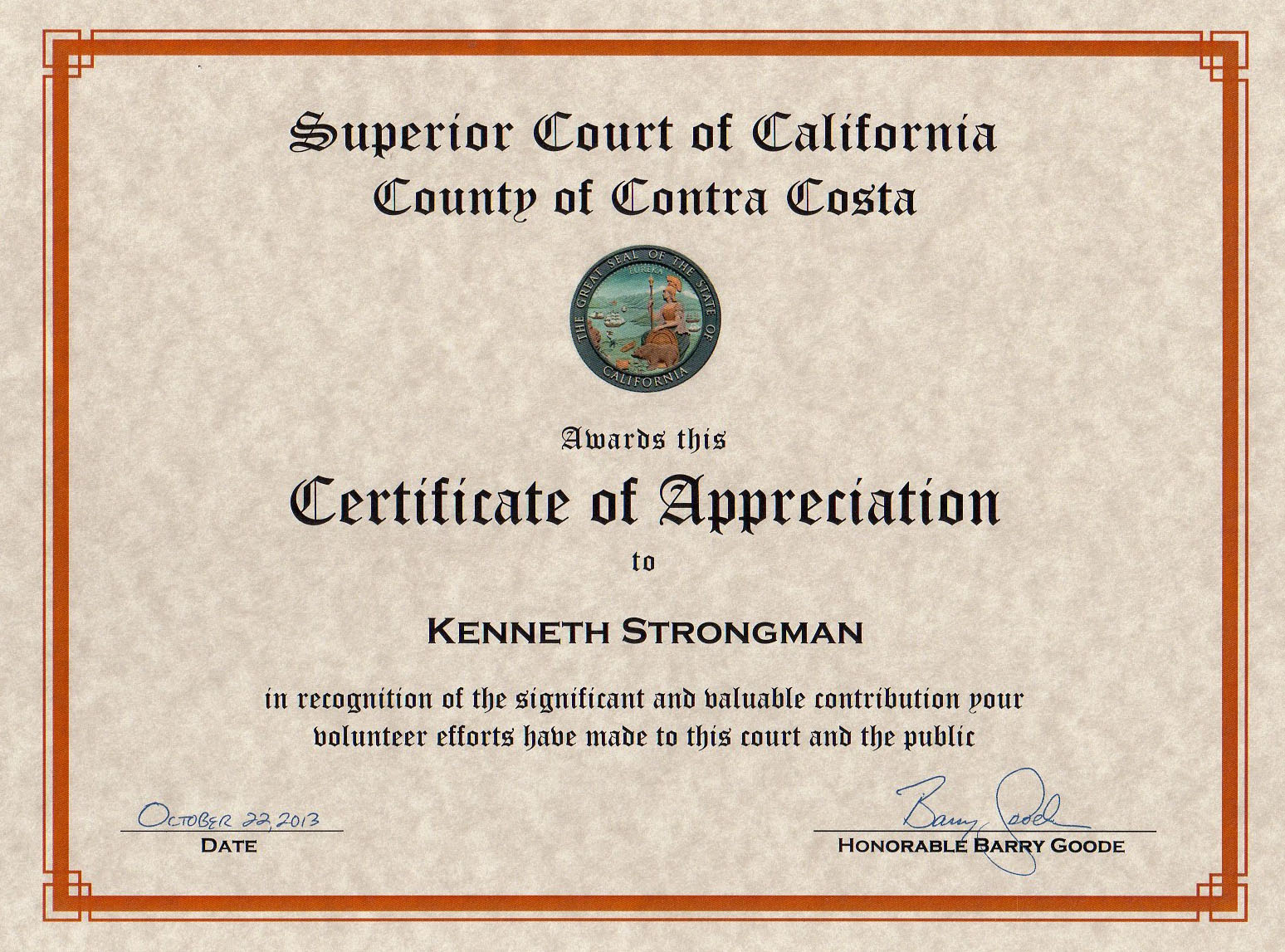
    The Contra Costa Superior Court held a reception to thank the hundreds of volunteers from the legal and professional community who contributed their time and talent to support the court.  I was one of the volunteers so honored.

    The Presiding Judge, the Honorable Barry Goode said, “There have been so many setbacks as our budget has been cut over the past five years, we simply could not function as well as we do without you.  Your efforts as mediators, arbitrators, settlement mentors, temporary judges, discovery facilitators, docents, clerks and interns, CASA and clinic Volunteers have made all the difference.  We thank you on behalf of the parties with cases before the court, and the public whose access to their justice system you have supported.”

    I’m proud to be associated with this large group who has given of their time and talents to improve access to justice.

    Ken StrongmanAbout the Author: Ken Strongman (www.kpstrongman.com) has years of experience and a growing national reputation as a mediator and arbitrator.  He has successfully resolved more than a thousand disputes in the fields of construction defects, real estate, intellectual property, and employment.  He is also a Mediator and Arbitrator for FINRA.

    © 2020 Ken Strongman. All Rights Reserved. Please do not copy or repost without permission.

  • Don’t be afraid of anger – angry people can’t lie.

    NYLT_Ken Strongman 06Don’t be afraid of anger – angry people can’t lie.

    The first step to resolve any conflict is to defuse anger.  But do not be afraid of anger.  An angry person can’t lie because anger is a primitive emotional response.  To lie, you must control your emotions and turn on your intellect.  So when someone is angry, whatever they are telling you contains some truth.  Beware that this does not stop good actors.  A good actor merely appears to be angry as they try to control the situation

    There are several reasons for anger:

    To vent. An angry person needs to let off steam and release the anger that may have been brewing for a long time.  To resolve the conflict you need to allow this to happen, but try to control it by reframing their issues. 

    To get the listener’s attention. An angry person wants to know that you are paying attention.  Use good listening skills to demonstrate that you are paying attention.

    To be heard. An angry person wants someone to listen to their point of view.  To resolve the conflict, you need to acknowledge the feelings you hear so that the speaker knows you appreciate how angry they are.

    To be understood. An angry person wants someone to appreciate how they feel.  Therefore try to empathize with their experience so that they feel you understand the situation, and acknowledge their ‘right’ to feel the way they do.  This does not mean that you should agree with their justification.  You do want to remain neutral in the conflict and not pick sides.

    **For the last decade I’ve been involved with leadership development of tomorrow’s leaders.  Using my expertise, I am training the youth leaders in conflict resolution.  This blog is adapted from my training materials. 


    Ken StrongmanAbout the Author: Ken Strongman (www.kpstrongman.com) has years of experience and a growing national reputation as a mediator and arbitrator.  He has successfully resolved more than a thousand disputes in the fields of construction defects, real estate, intellectual property, and employment.  He is also a Mediator and Arbitrator for FINRA.

    © 2020 Ken Strongman. All Rights Reserved. Please do not copy or repost without permission.
  • Task #21: If something happens in the mediation that irritates you, what will you do to get back on task?

    Ken Strongman Mediation Tasks 06If something happens in the mediation that irritates you, what will you do to get back on task?

    The resolution of a dispute does not just occur on the day of the mediation.   Each participant to mediation needs to prepare their own strategy for negotiation in the settlement.  Based on my experience as a mediator, these are a collection of tasks each participant needs to complete and to discuss with their council and the mediator before the mediation.

    How will you help get things back on task if that happens?  Things happen in mediation.  Sometimes it is the realization that the person that caused the dispute is sitting across the table from you.  You have just been confronted with the fact that you still have to deal with them whether now or in court.  You need to develop a game plan for getting back on task and settling the dispute.  It might be a private caucus or just a break.  It might be a continuance of the mediation itself to another day.  Communicating your needs to the mediator will help get things back on task and help settle the dispute.

    Will you risk your future financial interests to avoid uncomfortable discussions now?   This is the question you must keep in mind.   Mediation can be quite uncomfortable.  Mediation is conflict at its best.  But settlements do happen and are worth the discomfort.

    Will you accept a satisfactory offer to settle, even if you are very resentful about how you’ve been treated?  At some point you must make the decision that you want to settle the dispute and move on to better days.  It is important to make this decision before you come to the mediation.  If you do not want to settle, and want to continue expending the emotional energy, not counting the expense of litigation, then mediation will not be effective.

    Ken StrongmanAbout the Author: Ken Strongman (www.kpstrongman.com) has years of experience and a growing national reputation as a mediator and arbitrator.  He has successfully resolved more than a thousand disputes in the fields of construction defects, real estate, intellectual property, and employment.  He is also a Mediator and Arbitrator for FINRA.

    © 2020 Ken Strongman. All Rights Reserved. Please do not copy or repost without permission.
  • How long should mediation take?

    FAQ_Mediation Golden Gate long
    How Long?

    How long should mediation take?

    We have grown used to life happening instantaneously. What we forget is that despite all the fast and furious technology, we remain human beings. We may be more sophisticated overall, but are otherwise no different than we were thousands of years ago. Our thought processes and decision-making ability have not evolved along with technology and to expect otherwise is to set ourselves up for disappointment, if not failure.

    Too many people approach mediation as a finite process, allowing only two or three hours, with the expectation that the dispute will either be resolved or it won’t, but the process will be complete. Sometimes they are correct, but in most cases, this is a mistake that dooms the process to failure. Regardless of the dispute involved, mediation is a personal process that needs to occur in human time. Without exception, at least one of the participants in the mediation will have some very personal issues to confront and assess in making the decisions asked of them. Because the point of mediation is “resolution” rather than merely “settlement”, it is unfair and often impossible to rush this.

    It is always best to have an open-ended amount of time available when scheduling mediation, in order to allow for the possibility of prolonged discussions. If you are unable, for whatever reason, to give the process this time in a single session, let me, as your mediator, know at the outset, and allow for the possibility of further discussions in the future.

    Allowing people the ability to process information in their own time, whether at the mediation session or subsequent sessions, will lead to greater contentment in resolution and a greater likelihood of finality to the dispute involved.

    Ken Strongman, MediatorAbout the Author: Ken Strongman (www.kpstrongman.com) has years of experience and a growing national reputation as a mediator and arbitrator.  He has successfully resolved more than a thousand disputes in the fields of construction defects, real estate, intellectual property, and employment.  He is also a Mediator and Arbitrator for FINRA.

    © 2020 Ken Strongman. All Rights Reserved. Please do not copy or repost without permission.